Hand In Hand With Mother Nature
 A Corner Of The Barn
 Every moment spent in the company of my family is precious. For though I write, once a month, about what is happening in my garden at Barleycorn, nothing matters more to me in life than my family. When they are here, it is as if time itself stands still, for my whole world revolves around them. The month of May whizzed past in a flurry of exciting trips to London and Paris, and a blissful week of having family staying here. Hence the reason for no posts from Barleycorn.
 Primula Florindae, Himalayan Cowslip
However, when they had all gone home and I had time to lift my head and look around me, I saw that Mother Nature, during three days of 100 mph gales, had managed to create an altogether different pastiche from the one I had envisaged. In place of tall, graceful plants such as Cirsium thistles, Filipendula and climbing Honeysuckles there is a new architectural madness...and yet, with a beauty of its own. Nature can surprise us in the most unexpected ways, and bring about a transformation which surpasses anything we could have imagined.
 The Cog-Wheel Beside The Barn
Two Winters ago, a lengthy period of snow and severe frost killed off tall shrubs growing in front of the Barn. 20 years' growth was decimated in one fell swoop. That Summer, I sowed a wildflower meadow of annual Poppies, Cornflower, Corncockle and Nigella. This year, all sorts of new seeds are growing there, many of which I did not sow. The wind, the birds and insects have brought seed, and Mother Nature has enhanced my original vision and created an amazing array of wildflowers amongst the cultivars.
 Mecanopsis Cambria, Welsh Poppy and Hoverfly
As well as the original seed I sowed, there is a scattering of Pink Campion, Welsh Poppies, Ox-Eye Daisies, Forget-Me-Nots, Honesty, and White and Blue Polemonium. Although I do have these growing in other parts of the garden, the wonder and beauty of their appearance in the flower meadow is the magic that Nature has created. It reinforces the idea that gardening with Nature can be inspirational...another force at work with us.
 Lunaria Annua, Honesty Seed-Pods
As gardeners, we cannot help but see that nothing stands still. Always and everywhere, there is constant change. Each plant has its season, followed quickly by its seed-time. No sooner are we admiring a flower in full flow, then it is gone.
' But pleasures are like poppies spread,
You seize the bloom, the flower is shed'
Robert Burns
Honesty is one of those plants which is every bit as exciting in seed-form as when it is blooming. In fact, it spends more time with us in seed-form and sheds its outer skin in Autumn to reveal the silver 'coins' so loved by floral artists.
 Under A Weeping Birch Tree
Many years ago, I scattered a packet of Forget-Me-Not seed around a tiny Weeping Birch tree. Twenty years later, we have a carpet of those seeds, mixed with Pink Campion, Ox-Eye Daisies, Oriental Poppies, Welsh Poppies, Alchemilla Mollis, Wild Strawberry and Foxglove. And yet, I did not sow any of the other seed there. It is all due to the magic of Mother Nature weaving her tapestry.
 Purple Iris
We have Yellow Flag and Blue Sibirica Irises growing happily in and around our ponds. Their rhizomes enjoy being in boggy ground or in water. We do have several Bearded Irises, whose names, sadly, are now lost in the mists of time. These do not flower faithfully each year, because, as my cottage garden gets busier, their rhizomes are not getting enough sunshine to bake them. When they do flower, however, they bring such luxurious colour, it takes our breath away. I love their shape and form, the the melange of colours and the velvety touch of the petals. For all those reasons I enjoy creating watercolour paintings of them. They are definitely in my top ten favourites.
 Orange Oriental Poppies, Johnson's Blue Geranium and Alchemilla Mollis
June is the month when our Oriental Poppies bloom. So far, we have had fierce gales and cold temperatures of 9 degrees...not what anyone would desire for Summer weather. That's why I love my Poppies. Their vibrancy and beauty cheers me up no end. Their transience reminds me to enjoy each day, as life passes all too quickly. Later this month we also have scarlet ones, called Curly Locks; white ones, called Perry's White; and pale pink ones, called New Dawn. I adore their deep inky-black anthers and their dinner-plate-sized heads, and especially when Bumble Bees nestle in their centres, as if they had landed in Paradise.
 Cirsium Thistles, Alchemilla Mollis and Aquilegia
Once the fierce gales had stopped, we went out to survey the damage. There was no sign of the Circiums, which, two days previously, had stood 8 foot high - tall and proud - creating an architectural feature at one corner of the front pond. Instead, the stems were lying prostrate on top of the surrounding plants. Everything looked spoiled and washed out. Yet, from the debris came a myriad of heads which lifted themselves upwards, towards the light and created a pleasing blend of colours against the lime-green of the Alchemilla and blue of the Aquilegia...and the gales saved me the job of staking them.
 Rodgersia At The Front Pond
When I look at all the shades of green in this photo, I see the promise of Yellow and Blue Irises to come and a pond filled with beautiful Water Lilies. But, right at this moment, I love the different greens. Everything goes with green...even red. Green is such a peaceful colour...a perfect foil and background for everything else in the garden. Rodgersia is another of those great architectural plants to have in a garden... and the texture of the leaves is another bonus.
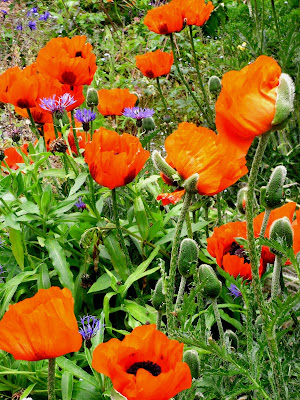 Orange Oriental Poppies
I did not plant these Oriental Poppies. I have a cluster growing opposite them...and, through time, the wind blessed me with this splendid group. Over the years, everything I have growing opposite them, has taken up position adjacent to them and supplied me with a carpet of flowers growing all the way along a hedge bordering the drive.
 Oriental Poppies And Blue Centaurea
As you can see, both sets of Orientals have been blown over by the gales, and yet, they look graceful and natural, having lifted their heads up to the light. I love their hairy leaves; their large buds; the way the flower-case opens; the play of light on their petals, which can change them from fiery red to orange to transparent golden yellow; and the pepperpot seed-heads in Autumn. There is even beauty in the fallen petals lying on the ground.
 Aquilegia Nora Barlow
A few days ago, when it was windy, I went out for a leisurely stroll around Barleycorn to take video snippets and the photographs I have used in this post. You will see all these flowers, and lots more, in the footage. Taz, the Barn cat, led the way, as always, and stopped where I stopped, and seemed as if he, too, was drinking in the beauty of it all. I hope the video plays all the way through. If not, try it again.
 Taz, The Barn Cat, Asleep In The Sun
The music I chose to accompany the video is Karl Jenkins' 'Benedictus' from The Armed Man-A Mass For Peace. It has a measured pace and is quiet and contemplative...music to soothe the soul. I enjoyed my walk, and I hope you do, too. My video is called A Windy Walk Around Barleycorn in June, 2011.
 Cirsium Thistles, Alchemilla Mollis and Aquilegia
Once the fierce gales had stopped, we went out to survey the damage. There was no sign of the Circiums, which, two days previously, had stood 8 foot high - tall and proud - creating an architectural feature at one corner of the front pond. Instead, the stems were lying prostrate on top of the surrounding plants. Everything looked spoiled and washed out. Yet, from the debris came a myriad of heads which lifted themselves upwards, towards the light and created a pleasing blend of colours against the lime-green of the Alchemilla and blue of the Aquilegia...and the gales saved me the job of staking them.
 Rodgersia At The Front Pond
When I look at all the shades of green in this photo, I see the promise of Yellow and Blue Irises to come and a pond filled with beautiful Water Lilies. But, right at this moment, I love the different greens. Everything goes with green...even red. Green is such a peaceful colour...a perfect foil and background for everything else in the garden. Rodgersia is another of those great architectural plants to have in a garden... and the texture of the leaves is another bonus.
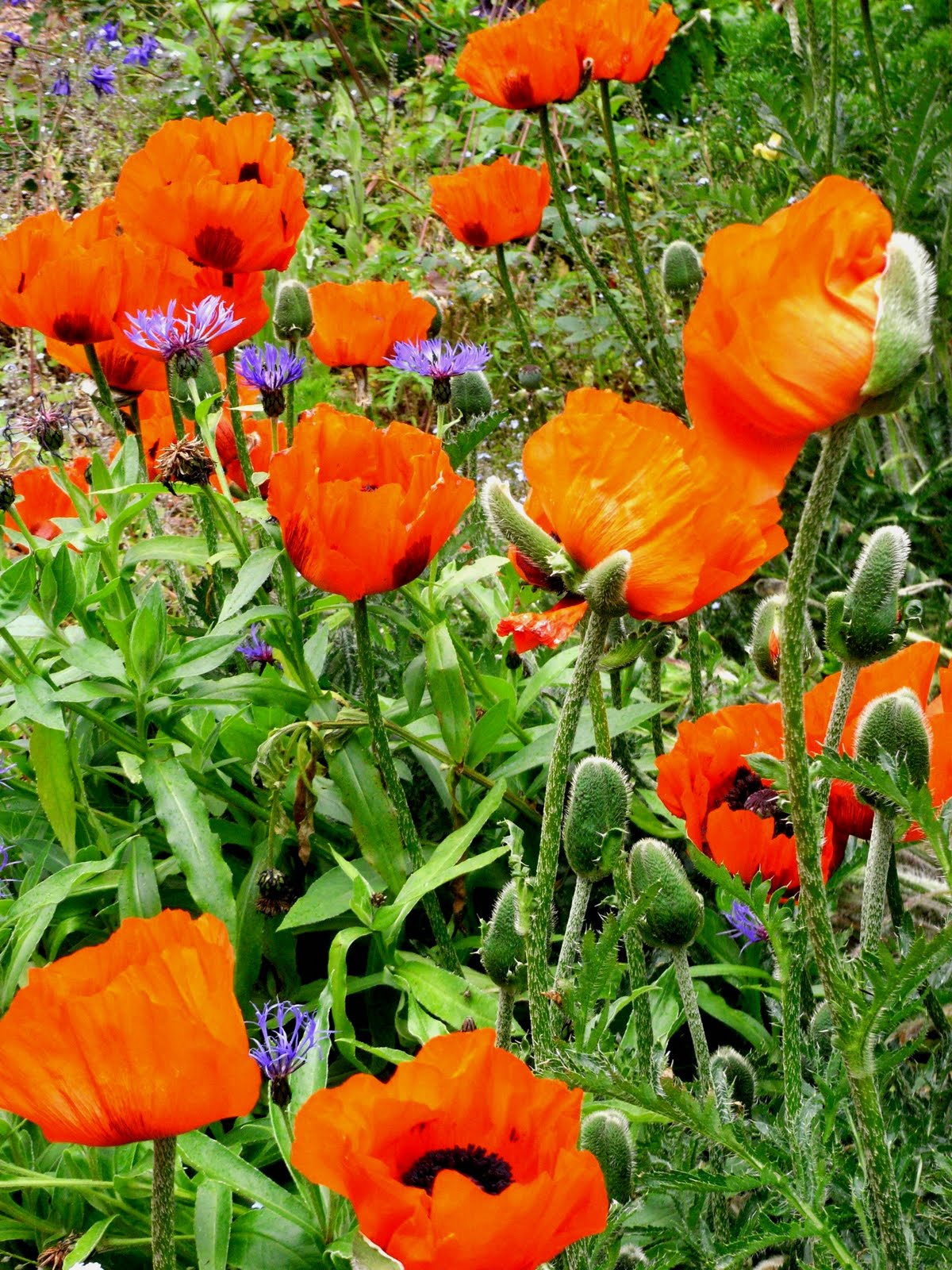 Orange Oriental Poppies
I did not plant these Oriental Poppies. I have a cluster growing opposite them...and, through time, the wind blessed me with this splendid group. Over the years, everything I have growing opposite them, has taken up position adjacent to them and supplied me with a carpet of flowers growing all the way along a hedge bordering the drive.
 Oriental Poppies And Blue Centaurea
As you can see, both sets of Orientals have been blown over by the gales, and yet, they look graceful and natural, having lifted their heads up to the light. I love their hairy leaves; their large buds; the way the flower-case opens; the play of light on their petals, which can change them from fiery red to orange to transparent golden yellow; and the pepperpot seed-heads in Autumn. There is even beauty in the fallen petals lying on the ground.
 Aquilegia Nora Barlow
A few days ago, when it was windy, I went out for a leisurely stroll around Barleycorn to take video snippets and the photographs I have used in this post. You will see all these flowers, and lots more, in the footage. Taz, the Barn cat, led the way, as always, and stopped where I stopped, and seemed as if he, too, was drinking in the beauty of it all. I hope the video plays all the way through. If not, try it again.
 Taz, The Barn Cat, Asleep In The Sun
The music I chose to accompany the video is Karl Jenkins' 'Benedictus' from The Armed Man-A Mass For Peace. It has a measured pace and is quiet and contemplative...music to soothe the soul. I enjoyed my walk, and I hope you do, too. My video is called A Windy Walk Around Barleycorn in June, 2011.