Saturday, 28 August 2010

Bobby-Dazzlers, Every One!


Small Tortoiseshell Butterfly

The month of August is high Summer for us, the time when the garden has a blowsy, overgrown appearance. Foxgloves hang heavy with next year's seed. The majestic stems of Verbascums, stiff Oriental Poppy pepperpots, and the tangle of spent growth on the Geraniums, all now wizened and brown, conspire to say that Autumn is creeping in. But, into that tangled mess fly all the fairies, with their newly-painted diaphanous wings.


Peacock Butterfly on Inula Daisies


Their magical appearance never ceases to amaze me as I gaze upon their beauty with a heart full of joy and wonder. The fact that we are 225 metres above sea-level, and, therefore, colder and wetter, must have a bearing on the infrequent sightings of butterflies. Considering the layout of the garden has more nectar borders containing host plants for several species, than anything else, it has always saddened me to find so few sightings.


Red Admiral Butterfly

Throughout the Summer we see Small Whites and Large Whites on a regular basis. They lay their eggs on the patches of nettles, to which I give house-room especially to encourage butterflies. If I have grown Nasturtiums, as I have in my Summer meadow this year, their leaves will look like lace curtains by the end of the season.


Small White Butterfly

But...towards the end of August, we have this magical rainbow of colour...red, russet, azure blue, orange, bronze and creamy-white. They all congregate on the Inula Daisies. I have spread these around the garden over the years. But, it is always the patch on which the sun shines for most hours in the day which they prefer. Each probosis goes at it, hammer and tong, so to speak, as they gather their much-sought nectar. Each season many will breed, lay eggs and die. But the magic they bring is worth the brief visit, and, possibly, because of their infrequent appearance, much more appreciated than if they were flying around every day...though, for me personally, I would never tire of the company of wall-to-wall butterflies in my garden.


Hoverfly on Inula Daisies

Competing for space on each flowerhead are the Hoverflies, Bumble Bees and Bees, as well as Wasps. They are no less welcome as each has a part to play in the web of life which keeps my garden organic and chemical-free and thus better for the environment. Every one is a pollinator, though most people are surprised when I tell them that applies to Wasps too, and that they are not simply here on earth to torment our picnics.


Small Bumble Bee on Teasel

Only today, I was reminded of the story, by Simon Barnes in the Times, of the importance of Wasps and how it is they who invented paper by chewing woodpulp, and how the Chinese cottoned on to that ...and the rest is history. In fact there would be no history, no Shakespeare, no poetry without the Wasps inventing paper. So, perhaps we should salute them and sing their praises, rather than destroy them with the newspapers which we read from, thanks to them.


Banded Shell Snail

I have said this many times before in my journal...but, I allow Snails and Slugs to roam freely in my garden. I found this little fellow with his broken shell crawling away for safety under the patio. They are the dustmen of the garden, feeding on the rotting plants, and, in turn, becoming food for Thrushes and other birds, and the colony of mature frogs in our two ponds. I know they can be naughty and eat new seedlings. But there are ways around that. I use coffee grinds and crushed eggshells to deter them and I grow many seeds in large pots with vaseline around the rim, which also hinders the Snails and Slugs from crawling into the pots. In that way, we live in harmony and they survive by eating spent leaves and rotting plants.


Blue Nigella, Love In A Mist

The Summer meadow I grew has continued to mature and grow, and grace the garden with much colour...reds, oranges and pinks of Poppies; blue, white and pink Cornflowers; blue and white Nigella; baby-pink Cosmos; inky-purple Cerinthe Major; several Sunflowers and hundreds of Nasturtiums. In the two videos I took this month, I have included more footage of the Summer meadow as it developed and matured.


Golden Barley In The Field Adjacent To Barleycorn

I leave you with this quote from Ecclesiastes 3 Verse 11.

He has made everything beautiful in its time.

xxxxxxx

The first video, called Fairy Magic At Barleycorn, August 2010, is of the Butterflies, Bumble Bees, Hoverflies and other pollinators which have paid us visits this month. I used Rimsky-Korsakov's Scheherazade to accompany the dancing insects.


In the second video, called High Summer At Barleycorn, August 2010, I walked around Barleycorn at various times to give an overall impression of what is in bloom throughout August. Jay Ungar's The Ashokan Farewell is the accompaniment. ( I hope both will play continuously...if they pause, try hovering the mouse over Play. It works for me when they stick. Happy Viewing...Enjoy!)


Friday, 30 July 2010

Contemplation In The Garden

Annual Poppy

Silence gives us a new outlook on everything.


Raindrops On Poppy

Nature, trees, flowers and grass grow in perfect silence.


Hoverfly On Poppy

See how the stars, the moon and the sun move in silence.


Flemish Poppy

God is the friend of silence.


Mixed Annual Poppies

In the silence of the heart God speaks to us.


Long-Horned Beetle On Poppy

In silence we are granted the privilege of listening to His voice.


Bumble Bee On Poppy

In silence He speaks to our souls.


Nasturtium

We need silence to be able to touch souls.


Danish Flag Poppy

Souls of prayer are souls of great silence.


Cerinthe Major

The essential thing is not what we say, but what God says to us and through us.


Corncockles

In that silence He will listen to us; there He will speak to our soul, and there we will hear His voice.


Long-Horned Beetle On Cornflower

When you have listened to the voice of God in the stillness of your heart, then your heart is filled with God.


Mixed Annual Poppies

Mother Teresa quotes from No Greater Love


Six weeks of heavy snow slithered down the high-pitched roof of the barn like an avalanche and flattened the tall shrubs which had been growing there for 19 years. Instead of moaning about my losses, I decided to create a little summer meadow. I chose mixed annual poppies, cornflower, corncockles, nigella, nasturtiums, sunflowers and packets of 'butterfly' seed. The results are to be seen in this first video, Summer Meadow At Barleycorn, July 2010. There are two pieces of musical accompaniment. The first is Vaughan Williams' Fantasia On Greensleeves, followed by Butterworth's The Banks Of Green Willow.
xxxxxxx


The Second video, called, Cornucopia At Barleycorn, July 2010, has one piece of music, Brahms' Violin Concerto in D major, 2nd movement. I thought there were too many flowers to talk about this month as July is one of the months when the garden is in full flow. I think most of you will recognise the plants apart from one which is not as commonplace as the others. I have only ever seen it once, growing in a friend's garden. It is a white bell called Codonopsis Convolvulacea. In one of the still images I am holding a bell so that you can see the pretty colours inside it. I hope you enjoy your walk around Barleycorn with me.


Monday, 5 July 2010

In The Summertime, When The Weather Is Fine

Across A Section Of The Back Garden

The month of June went by in a whirl of activity. We had wall-to-wall sunshine which meant we were able to sit out in our back garden with family and friends. Some came to stay; others for lunch, Afternoon Tea or dinner; and with some we went on holiday.


Annuals in Pots

This meant that I did not have time to visit my friends in Blogland...but, I shall do so this month. Normally, our really beautiful weather last for only a few days...but, this Summer, we have had weeks of sunny weather, which has made all the difference to the garden.

Underside of an Orange tip Butterfly

We have had early visits from butterflies and insects, hoverflies and interesting hawk moths. There has never been such abundant blossom on our honeysuckles and the plants, in general, have flowered earlier too.


Angelica

Dotted around the garden are stately Angelicas which have reached phenomenal heights. I am surprised they have not needed staking. From one tiny seed comes so much joy, both in the foliage as well as the globular seed-heads. They are particularly good for children to grow, as is the Teasel, because both grow to maturity quickly.

Mixed Foliage In The Front Garden

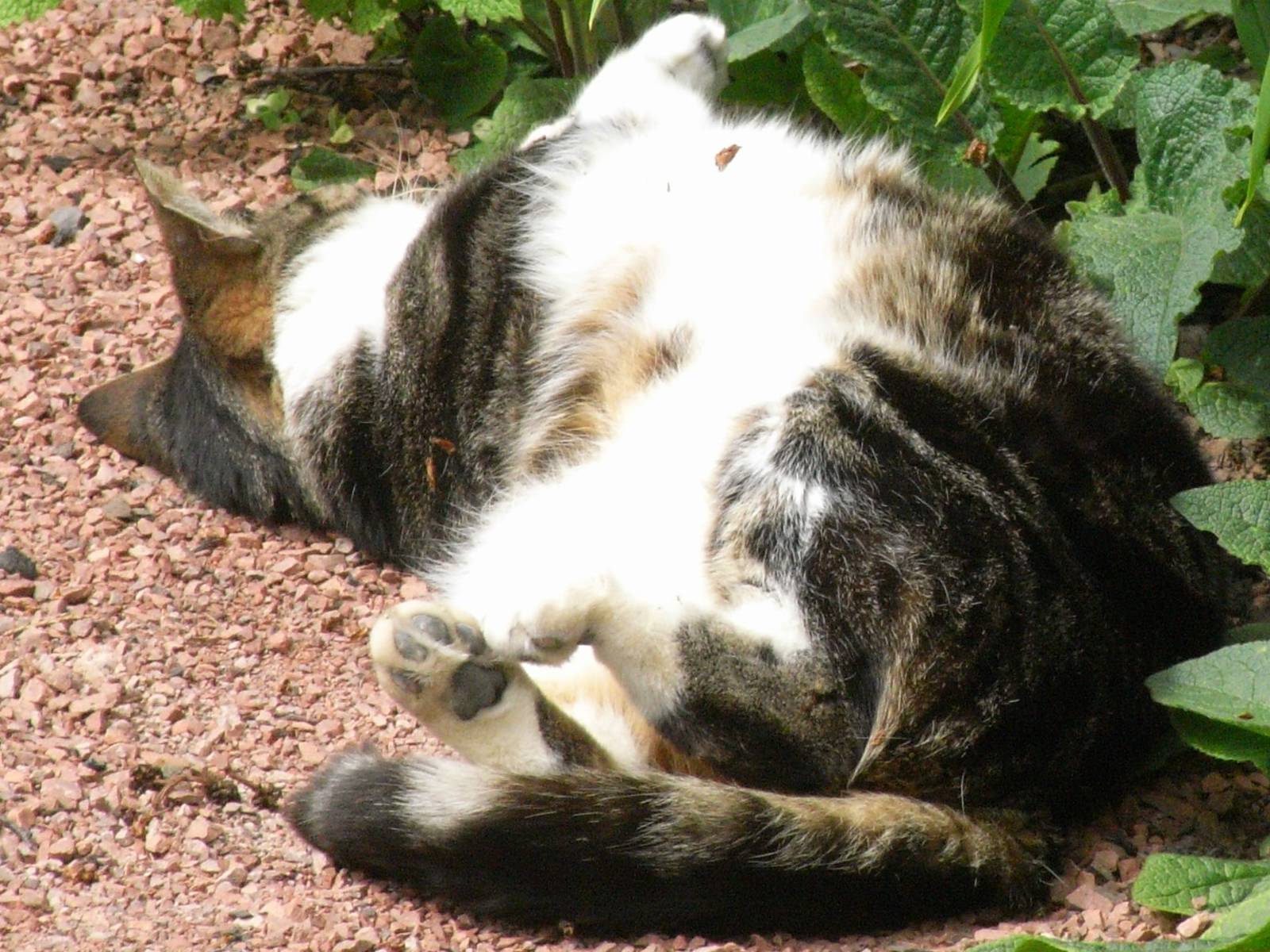
The bench in this photo faces the front of our house and gets the sun all day, so Taz, the Barn Cat, often snoozes there. It also affords privacy, so anyone passing along the road is unseen. As it faces one of our ponds we can sit for hours watching birds and insects bathing and drinking.


Bumble Bee On Cirsium Thistles

This Cirsium has grown to an amazing height of seven feet this Summer. The bees and insects adore the sustenance they get and we love their humming chorus. As, in previous months, I have tried to capture as much of the changes in the garden as I can through the video mode of my camera.


Taz, The Barn Cat

Our pets always seem to me to be in a permanent state of bliss. Nothing much phases them. Taz has dreamed away the hot sunny days, lazing in all the sheltered spots around the garden. On the sticky days he knew where the coolest places were too.


Papaver Orientalis, Red Oriental Poppies

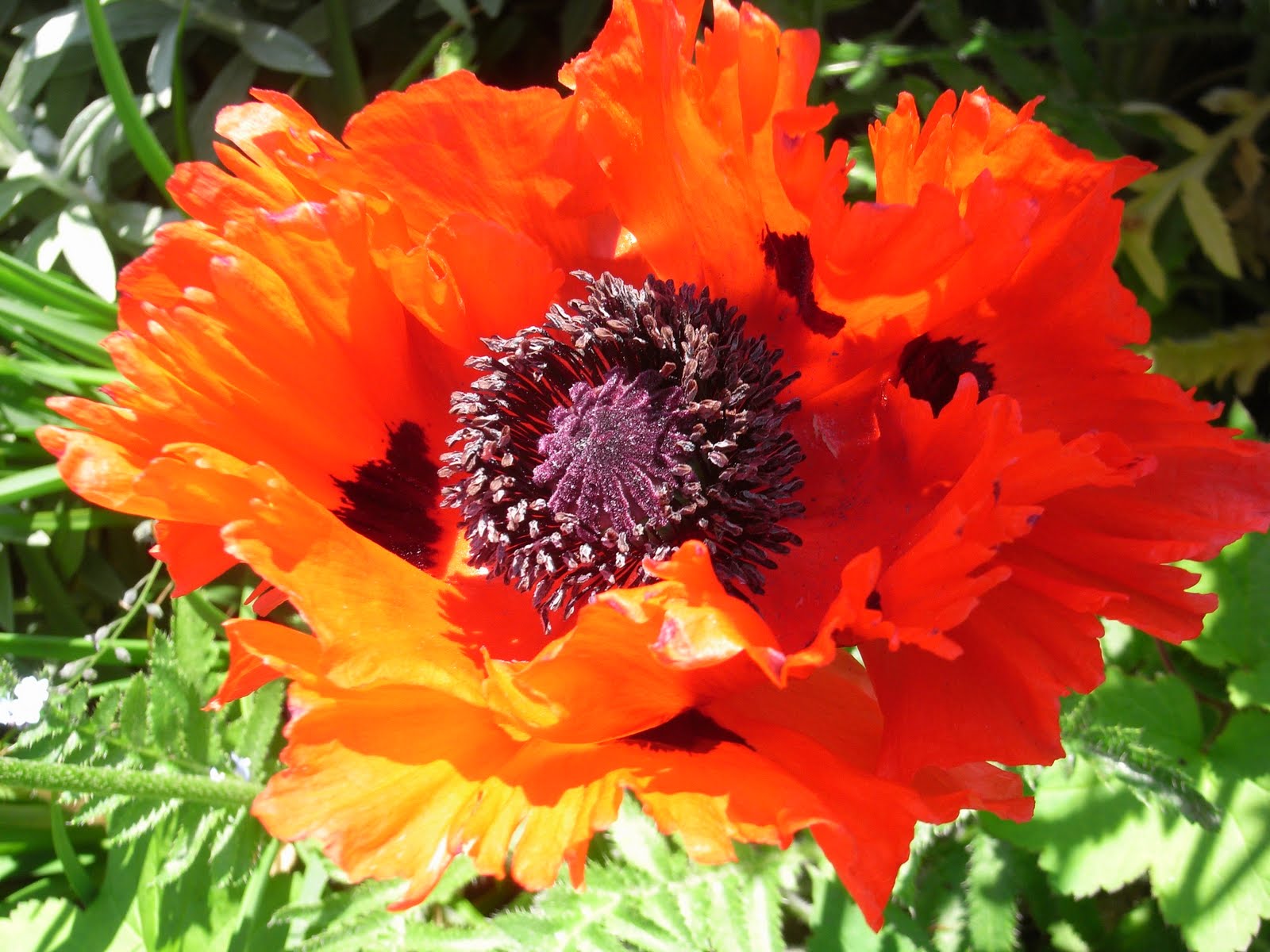
Our Oriental Poppies bloom for six weeks from the beginning of June...so, they are just going over now. For those who are not familiar with the garden, the main colour-scheme follows the cooler part of the spectrum with some white and yellow. But, the vibrant reds and oranges, and the cooler pinks and whites of the Oriental poppies brighten up the subtle hues of the rest of the year.


Papaver Orientalis Curlylocks

It's exciting to watch the garden come alive, day by day, with the dinner-plate sized heads, the enormous inky-black anthers and the large green seedpods of these poppies. Bees bury themselves in the anthers, too.


Papaver Orientalis Dawn Pink

This species is a new acquisition for the garden. Little spotted insects seemed to enjoy being in its head. I liked the pink markings, as opposed to the black, and the subtlety of the shade of pink. The first video is called Poppymania and the music I used for accompaniment is Pachelbel's Canon.


Papaver Orientalis Dusky Pink

You can also see some of my annual poppies on the video. The second video is called June Melody At Barleycorn and the music which accompanies it is Bruch's Violin Concerto No. 1 in G Minor.
xxxxxxx

Happy viewing...and I'll be visiting soon.


Saturday, 29 May 2010

Halcyon Days At Barleycorn In The Month Of May

Taz, the Barn Cat

Hal Borland is quoted as saying 'April is a promise that May is bound to keep' and I couldn't agree more. After such a long winter, with five weeks of snow and freezing cold, we have had a relatively mild May with a mini-heatwave into the bargain.


Orange Tipped Butterfly

The sunny weather brought the return of the garden fairies...the butterflies. So swift is the Orange Tipped in flight, that it took me a whole day to capture one photograph, though I managed to take video snippets of the Large White.


Wasp on A Centaurea

From the beginning to the end of the month my camera has been set, more or less, at video mode. All manner of interesting insects, bees and butterflies with their diaphanous wings, appeared, as if by magic, as the days grew warmer.


A Carder Bee, Bombus Pascuorum, on a Centaurea

Anyone within earshot of the garden was serenaded from dawn to dusk by several male Blackbirds singing their madrigals and the hum of the all-important bees, as they gathered nectar and pollinated the plants. Joining the Spring dance, the trees gradually donned lush Spring coats, and some even covered themselves in vibrant blossom.


Female Blackbird With Grubs

So far this year we have four pairs of Blackbirds nesting around the garden, three pairs of Swallows in the eaves of the barn, many Sparrows nesting in the ivy growing up the outside of the barn and a pesky Heron helping himself, unfortunately, to the colony of frogs in the two ponds.


Crab Apple blossom

Apart from chasing him away when I see him, there's not much else I can do, as I love all wildlife and believe that each plays its part in the magical web of life. After all, the ponds could not support all the tadpoles growing into mature frogs.


Pagoda Lilies, Erythroniums

Though we have seen several Martins flying overhead, so far, none has taken possession of the old nests...and a pair of Sparrows have now moved into one. The Martins were also a week late in returning this year, which may account for the Sparrows grabbing the main chance.


The Barn

Since April 2009, I have been keeping a record of photographs and videos of a few Great Spotted Woodpeckers which come to the garden. The slightest sign of movement and they fly off. It is usually their drumming which alerts me to their presence.


Great Spotted Woodpecker, Male

These Woodpeckers are about the same size as Blackbirds. The male has a red nape, while the female does not. The juvenile has a red hood. They all have red rumps. They are aggressive towards other birds at the feeders and think nothing of using their beaks to see them off.


Great Spotted Woodpecker, Female

In the video of the Woodpeckers, aggressive females commandeer the feeders and swing between them to chase off the smaller birds. Their behaviour always reminds me of Rudyard Kipling's poem...Now this is the law of the jungle...


Great Spotted Woodpecker, Juvenile

Even the juveniles are strong enough to play King of the Castle at the feeders, and, if hungry enough, they will fly at the smaller birds to shoo them away. I am so grateful for a fleeting visit, for, often, all I catch is a glimpse of the flash of red on their rumps as they fly off to the nearby wood.
xxxxxxx

Human subtlety will never devise an invention more beautiful, more simple or more direct than does Nature because in her inventions nothing is lacking, and nothing is superfluous.
Leonardo da Vinci
xxxxxxx

Enjoy the videos...and turn up the volume at the end of the second one, Halcyon Days At Barleycorn In The Merry Month Of May, to hear the Spring lambs bleating. The first, Great Spotted Woodpeckers, Apr09-May10, has Saint-Saens' Pianists for accompaniment.


Wednesday, 5 May 2010

Every Spring Is The Only Spring

Tadpoles In Egg Cells

Please click * (footnote before the videos) on each photograph to see the amazing detail, and you will see why, for me, Spring is the most marvellous season. I was born in the month of April, and each year I am filled with Spring Fever. Having not one, but, two ponds here at Barleycorn, I am fortunate to be able to observe each stage in the life-cycle of the common frog at close quarters.


Taddies With Gills

Each Spring I marvel at this miraculous spectacle of Nature with renewed enthusiasm. It matters not that I have witnessed it for each of the past twenty years since my Hubbie first created the ponds...for every Spring is the only Spring.


Tadpoles Swimming Freely

With my camera set to video mode, I went out each day and recorded the changes in their development, from spawn to tadpole. You can watch the results in the first little video, Barleycorn Taddies, at the end of this post and be filled with wonder at the metamorphosis.


Female Blackbird Gathering Nesting Material

As well as the frenzy of activity in the ponds, beginning each day with the Frog Chorus, we have also had the pleasure of being awakened by the Dawn Chorus, and a wonderful serenading Song Thrush...both of which are better than any alarm clock at enticing me out of bed. Because we have a lot of chaff left over from last year's spent flower stems, the usual suspects have been gathering their nesting material.


Blackbird's Nest

Each Autumn, I leave a crown of growth around my plants to protect them from severe frosts and to offer nesting material for the birds in Spring. This year, we have watched three pairs of Blackbirds, a Thrush, three pairs of Jackdaws and Titmice gathering chaff, moss, wool and twigs to make their nests.


Goldfinches And A Siskin

Nuts and seeds sustain the birds when they are feverishly engaged in building their nests. In the second video, Billing And Cooing, you will see a female blackbird using her beak to wrestle and tug chaff from the earth, for a whole day, and persevere until her beak could support no more strands, before flying off to a nearby Pine, where she began to weave her magic.


Siskin On A Garden Light

I do not use the word 'magic' lightly, to describe the truly wonderful creation of a bird's nest, for their intricacy never ceases to amaze me, knowing that, even with the use of a pair of hands, my effort would be a poor attempt. Though we found the nest lying on the ground the next day, the Blackbird began the marathon all over again, this time building the nest in a more sheltered Pine.


Double-Petalled Daffodil

Whenever our daffodils burst forth, I am always reminded of the exuberant song from the Mikado...
# The Flowers That Bloom In The Spring, Tra La #
... because they are further confirmation that Spring has arrived at last at Barleycorn. Another sign is the first appearance of 'our' Swallows, newly returned from their long trip from Africa to their nests in the Barn. This year we are fortunate to have three returning pairs.


Naturalised Daffodils

With the Swallows playing Spitfires, zooming in and out of the Barn from dawn to dusk each day, the car is once again sporting a dustsheet for the duration of our Barn visitors' sojourn. Further evidence of Spring is the fact that my log-piles have dwindled as pairs of Jackdaws replenished their nests in the Barn's three chimneys.


Orange-Centred Daffodil

There are five Dandelion plants in full bloom at the moment, given house-room in our garden so that Queen Bumble bees have sustenance when they crawl out of their underground hideaways each Spring... for our garden is very much one designed to encourage wildlife to take up residence.


Small Tortoiseshell Butterfly On Scilla

Small Tortoiseshell and Large White butterflies overwinter in the Barn. Several times over the years I have managed to rescue a few from cobwebs to enable them to fly off and begin their life-cycle. In the third video, Flowering At Barleycorn, you will see Taz, my constant companion, as I took the footage. Though our garden is very much in the early stages of Spring, with many joys still to unfold as the season progresses, I already feel I am bursting with joy, blessed with the wonder and majesty of it all and feeling positive about what the garden means in terms of conservation...reminding me we are the stewards of the earth.
xxxxxxx

Don't forget to turn up the volume to enjoy the musical accompaniment and the sounds of Nature in the background. Enjoy!
xxxxxxx

Click * If you decide to click to enlarge a photo, you can then click on a corner and the photo will open up to the size of the whole page...and then you will see everything in glorious detail!


The music accompanying Barleycorn Taddies is Delibes' Pizzicati.


The music accompanying Billing And Cooing is Kriesler's Schon Rosmarin.


The music accompanying Flowering At Barleycorn is Grieg's To The Spring, from his Lyric Pieces.