Wednesday, 17 June 2009

Barleycorn Meditation In June

Papaver Rhoeas, Cornfield Poppy
When I was born, God blessed me with the gift of wonder, which nurtured my passion for life in general, and the world of Nature in particular. I seem to observe the flora and fauna around me as if wearing the rose-tinted spectacles of a young child exploring everything in the environment for the first time. That's why, for me, the appearance of the first cornfield poppy in our garden in June causes my heart to skip a beat.

Swallows At Barleycorn

Along with this gift came the blessing of optimism, which helps me to look at the broader picture in life, and, in times of adversity, helps to sustain me. I believe that we are the stewards of the earth and that we are meant to live in harmony with Nature in all its glory. When I contemplate the difficulties facing a pair of swallows returning all the way from Africa in order to rebuild their nest in the same place in our barn, year upon year...well, that blows my mind!

Mixed Aquilegia, Columbine

How do they do it? Each Spring I await their arrival with bated breath, and my spirits soar when I hear their excited twittering overhead. Our barn doors have a space at the top where they swoop in and out to their nest, like trapeze artists, with perfect ease, never missing the mark. Taz and Cookie, the barn cats, are well-used to sharing their quarters over the Summer months with two messy broods of chicks.

Mecanopsis Cambria, Welsh Poppies

Even though the path behind our barn is 70 foot long, it is a mere metre in width. When we came here, almost eighteen years ago, it seemed appropriate to sow wild flowers along the length of it. Some years biennial foxgloves grow in profusion, their long tapering spires offering tunnels of delight to foraging bees. This year, it's the turn of the Welsh poppies to hum with droning bumblies.

Cepaea Hortensis, Banded Snail

And what about the place of the humble snail in my garden? Loving all God's creatures as I do, I could not possibly imagine that my duty should be one of extermination for the entire population, for how else would the beautiful song thrush, which serenades me each morning, thrive? Or, for that matter, the colony of frogs which breed in the two ponds? And what would our resident hedgehogs feed on?


Christophii Alliums, Ornamental Onions

Wildlife will only thrive in a nurturing environment and form part of the magical web of life in our gardens with our help. That does not mean to say I skip for joy when I discover a row of seeds has disappeared overnight. Instead, I grow some of my salad crops in pots and in long containers, as well as in the earth. That way, there's always some to spare. I find eggshells and coffee grinds helpful deterrants, as well as a border of Scotch marigolds or alliums.


Painted Lady Butterfly On Polygonum Superbum, Bistort


Another exciting visitor to arrive in our garden from Africa each year is the Painted Lady butterfly. This year there seems to be a mass migration, here in the UK. This one is feeding on the bistort, Polygonum Superbum, which I grow as an early nectar border plant beside the pond at the front of the house. Some people find the bistort a noxious weed, and, on first appearances, it does not seem to have the wow factor, but my feelings positively warm to it when I observe so many butterflies, bees and insects foraging on its flowers.


Papaver Orientalis, Double-Petalled Oriental Poppy


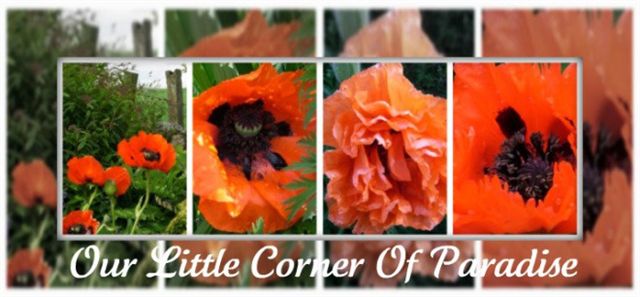
The colour palette in the garden consists mainly of shades of pink, blue, mauve, lavender, violet and purple, with some yellow and white, here and there. But, all that subtlety changes dramatically in the month of June, when the Hallelujah Chorus of the garden - the Oriental poppies - punctuate the otherwise muted tones. I am not alone in feeling attracted by the enormous vibrant redheads, with their striking inky-black anthers, for the bees pay them frequent visits too.

Lychnis-Flos-Cuculi, Ragged Robin
The wild lychnis, otherwise known as Ragged Robin, has a special place in my heart as it transports me back in time to childhood walks with my family, when we were allowed to gather and press a collection of wildflowers in a scrapbook in order to identify them. When my own children were growing up we took pocket guides with us for identification. Back home, we would draw sketches of the plants and the wildlife we had seen. I grow my Ragged Robins at the edge of the pond as they prefer their feet in damp places.

Papaver Orientalis, Dusky Dawn, Oriental Pink Poppy
The flamboyant Oriental poppies need not clash with the quieter tones in the garden as they come in gentle shades of pink, such as the one above, and Patty's Plum is a lovely shade of blackcurrant-purple. I also make room for a lovely classic white one called Perry's White.

Bombus, Bumble Bee On Lupin
My favourite sounds in the garden are the birdsong and the humming of the bees. For me, nothing exudes that magical quality of June in the garden more than bees' humming. Nothing makes me happier than to potter away the afternoon, thinking of nothing in particular, with the birds and bees for company.

Papaver Orientalis, Double-Petalled Oriental Poppy
Raindrops on poppies is also a common sight in the Barleycorn garden, for without the much-needed rain, my garden would not look as vibrant and lush as it does, and, never more so, than in the month of June. Even in their 'going over' period, I find beauty in the crumpled, frilly, translucent petals, and the discarded black anthers lying on the ground.

Rosa Zepherine Drouhin, Bourbon Rose
As far as I'm concerned the garden has to be a complete sensory experience, with smell coming to the fore in the Summer months. With that idea in mind, I grow a climbing Bourbon rose, called Rosa Zepherine Drouhin, outside one of the bedroom windows, so that its heady perfume fills the air on warm June days in particular. This year we have been blessed with a profusion of blooms. For me, this is a huge bonus as it is so difficult to grow roses in these parts as we are 225 metres above sea-level, with frequent winds blowing across the landscape.

Papaver Orientalis, Red Oriental Poppy
'Red and green should never be seen', goes the old adage. But, I love the combination. Green goes with everything as it is a perfect foil. With flowers as big as dinner plates, translucent petals for light to dance upon, ephemeral poppies add a touch of sophistication and glamour to the garden in Summer. I love the finely-cut, fern-like, hairy green foliage and the silky-textured, crepe paper petals of the ballgown flowers. You could be forgiven for thinking that the stunning blooms they produce would be difficult to grow, but nothing could be further from the truth.

Zygoptera, Red Damselfly
Red, blue and green damselflies flit around the ponds in June, adding a magical touch to the garden. With their two pairs of translucent, gossamer wings folded along their abdomen, they measure about 30mm in length. The adults feed on small insects and their larvae live on aquatic insects before emerging, after one year, as adults. I regard them as the fairies of the garden and find them very attractive to watch on sunny afternoons. Is anything more redolent of Summer?

Pots Of Salad Crops
It's amazing how many pots of plants can be grown from one bag of potting compost and a few packets of seeds. I also grow a few raspberry canes in pots, though I grow my strawberries in beds. Is there anything more exciting than eating one's home-grown produce, whether it be for a few weeks or a few months of the Summer?

Papaver Orientalis Turkenlouis, Oriental Poppy Curlylocks
Turkenlouis has to be the loudest Oriental poppy I grow. I love its serrated edges, the double-frilled petals and how they always hold their heads open to reveal the enormous seedbox and the black anthers. I grow it beside a yellow hemerocalis for contrast.

Hosta Sieboldiana
Hosta Sieboldiana has large, deeply-ridged, heart-shaped leaves of glaucus blue, and, when it rains, it holds enormous droplets of water. I find that most attractive. In all eighteen years here, the slugs and snails have never attacked my hostas...and I have many varieties of them. It is a dramatic plant in any border.

Papaver Orientalis, Oriental Poppies By The Front Pond
Over the years, I have filled my cottage garden with so many plants, there is little room for weeds to grow. A few years ago, in Springtime, while the plants were still small, I covered the areas between the flowers with bark, as a weed suppressant. It also helps as a mulch in dry weather.

Taz, The Barn Cat, In The Back Garden
Along the back wall bordering the adjacent farmer's field, I grow a nectar border for insects and butterflies, which, in turn, feed the birds. Taz, one of the barn cats, likes to lie in wait for voles and shrews. Over the years, I have been chasing my tail trying to combat the fierce winds blowing down my taller flowers, such as delphiniums and aconites, that I decided upon a plan of action for the whole garden.

Geranium Psilostemon
For two days in the month of June, I go around the whole garden with canes of varying sizes and thin green wire and insert them as a defence barrier. It looks a bit like invisible mending, for only the sharpest eyes could detect where I have been. It has been most successful over the past few years, as everything is held upright till the end of the season and the paths are kept clear. Best of all, on wet days, it is possible to walk around the entire garden without wet plants brushing against one's legs. This tall psilostemon geranium would be flattened by our strong winds in a day if it were not held upright. I love its magenta-coloured flowers as well as its attractive foliage.

Housemartins At Barleycorn
This year our housemartins did not arrive till the first day of June. But, we are lucky to have them. Normally we have three pairs building in the three apexes of the house, sometimes with triple nests in each...this year, only one pair. They have friends who join them in the evenings when they wheel overhead, and, to our delight, swoop and dive across the ponds catching insects on the wing, along with their other friends, the swallows.

Chaerophyllum Hirsutum Roseum, Cow Parsley
Cow parsley is usually a plant of the wayside, but I like its habit and grow some in my nectar borders. I also have the garden cultivar - chaerophyllum hirsutum roseum - which has pale pink blossom. It needs to be in a mixed bed as it can easily take over if left in too big a space, but it pays its weight in gold as far as the bees and insects are concerned.

Ranunculus, Meadow Buttercup
Do you like butter? Again, because of happy childhood days spent making daisy and buttercup chains, I grow ranunculus beside my wild cornfield poppies. A garden, for me, has to contain dreams and evoke memories, making room for the wildflowers as well as the cultivars in order to create a sense of soul and romance. It must tell its own story.

Nectar Borders In The Back Garden
This photograph shows a section of the garden made up of nectar borders. But, without them, I would not have so many varieties of visiting bees, insects and birds, which, in turn, bring visiting mammals. I have often been asked which flowers are my favourites. If I must choose it is a toss-up between wild poppies and foxgloves. But, each flower in season is a favourite...so many hues, so much individuality, such a variety of perfumes, each with their own story.

Borage Officinalis, Borage
Another of my favourites is the borage. The wonderful blue, (though sometimes white or pink) five-petalled, star-shaped flowers hanging in profusion, the tall graceful way it grows, the hairy leaves...all are attractive to me, and so nectar-rich for the bees that beekeepers often grow this plant.

Cirsium Rivulare Atropurpureum, Ornamental Thistle
My cirsium grows between six and seven foot tall. It is a very elegant plant, very stately with amazingly large leaves, considering the thistle heads are relatively tiny. Again, the bees adore it, as you will see in the little video I have taken.

Papaver Orientalis, Oriental Poppies At The Stane Dyke Wall
Although we have fierce winds blowing across our open landscape, I love to stand at the fence and watch the wildlife across the field. Sometimes there are buzzards mewing overhead, or larks making my heart soar with their amazing songs. Perhaps that's why I love Vaughan Williams' The Lark Ascending so much. Barley is the main crop grown in the adjacent field...and I love to hear the wind through the barley and watch it making waves while the barley is still young enough to bend.

Lupins, Geraniums, Aquilegia
The lupins in this photo have the most exquisite perfume. I wish I could bottle its scent and open it on cold Winter days to remind me of summery June. Over the years I have grown so many varieties of aquilegias....and they seed all over the place, which is a bonus to me. They are so enduring and add their own magic to our cottage garden. I love their 'Granny's bonnets', as we call them hereabouts, and their form and foliage, which can vary between acid green and purple-green.

Yellow Flag Irises In Back Pond
Yellow flag irises, also known as Jacob's sword, are stately plants of wild ponds...and of our ponds too. Again, so reminiscent of my childhood days at my Granny's cottage, I couldn't bear to be without them, for, though they used to be a common sight in the wild, with so many of the farmers' ponds being drained for intensive farming methods, they are growing scarcer each year. One school of thought says they are the origin of the fleur-de-lis in heraldry.

Mixed Nectar Borders In Front Garden
These borders are in the front garden. One whole bed contains varieties of geraniums, which flower for months on end, and if cut back, return with a final flush in September. I find the geranium a 'must' as they are easy to look after being disease-free, and bloom for long periods of the Summer.

Rosa Glauca, Rose
Lastly, I have chosen to show you my rosa glauca, the foliage of which is a wonderful shade of grey-purple with purplish-red stems. I am always told they do not do well in exposed windy sites, but, for some reason, they do well for me. Apart from the attractive cerise-pink flowers, in Autumn they have unusual wine-red fruits which feed the birds. The photo is well worth enlarging to see all the amazing tones in the foliage....and to spy the sweet little insect on the flower. The birds eat the fruit and leave me many seedlings scattered around the garden. I pot them up and grow some for myself, some to sell at garden fayres and some to share with friends and fellow gardeners.
xxxxxxx
The little film below was taken over a few days in June, and is made up of many little videos. If you turn up the volume you will hear the wonderful birdsong and the buzzing of the bees, the winds blowing and cars passing by, as people go about their daily business. It lasts for nine and a half minutes, so, if it sticks a bit, please be patient. The music, which plays through twice, is Thais' Meditation by Massenet. Enjoy!
xxxxxxx
If you click to enlarge each photo, you will find when the photo was taken, and the botanical name as well as the common name of each plant.

Thursday, 21 May 2009

Fancy A Spot Of Pond-Dipping?

In the months of April and May, the Barleycorn ponds are awash with golden cups of sunshine of the caltha palustris plant, more commonly known as marsh marigolds. In churches in medieval times, they were given in tribute to the Virgin Mary at Easter and were called Mary Gold. I grow them because they remind me of happy childhood days when my brother and I would take our nets and go pond-dipping and I would gather a little bunch of sunshine to take home to my Mum.
Although the lily flowers are not yet in bloom, I find the beautiful shapes and hues of the leaves so attractive. Covering roughly a third of each pond, they help to keep out the light which enables algae to grow. They also provide hiding places for the many creatures which live in the ponds.

Unlike their garden cousins which will devour fresh young shoots, the lymnaea stagnalis or great pond snails mostly tend to live on decaying plants, algae and debris in the pond, which makes them very useful. The two in this photo are foraging on the roots of a ranunculus plant which has come adrift from its mooring in the soil. They are greyish-brown in colour and around 60mm in length.

I find them fascinating to watch as they come part-way out of their shells to feed and often float upside down on the surface of the water as they go about their business acting as pond dustmen clearing up the rubbish and keeping everything clean and healthy. Because they absorb oxygen through their skin, they can live underwater for several months. I feel glad when I find a long string of their eggs under the leaves of aquatic plants because it is proof that they are thriving. In Winter they hibernate in the mud at the bottom of the ponds.

This tiny creature is a ramshorn snail and belongs to the family Planorbidae. There are many of these little snails in the ponds. Their shells are coiled into flat spiral discs. They are also vegetarian and graze on algae covering the plants, as this photo shows. They tend to grow to 18mm. What amazes me is the fact that all the creatures found their own way into the ponds.

If you are interested in looking at the creatures in more detail, click on each photo to get up close and personal. This photo shows the larva of the great diving beetle. They are voracious carnivores, feeding mainly on tadpoles and other insects - including their own brothers and sisters - which they grab with their pincer jaws. They look like scorpions as they keep their tails upright while swimming. They push their tails up out of the water to take in oxygen through an air hole in their tails.

This photo shows a pair of dytiscus marginalis, great diving beetles, at the breeding time in April. As it was a cloudy day, the water looks dark and murky. They are the adults of the larva in the previous photo. They actually pupate on land and then return to the water, though I have often had a fright when I have seen them flying as they look a bit like cockroaches.

The water boatman is hilarious to watch as it swims along upside down carrying a bubble of air on its abdomen. It has two pairs of legs- a short front pair, and a strong hind pair - which it paddles like oars. They grow to around 20mm in length. I would need an underwater camera to show you his large red eyes. They live on tadpoles and insects, and can eat fish too, though we have none in our ponds. The adults can fly and move between ponds.

Here we have a pair of Gerris lacustris, pond skaters. They are mating while resting on a lily pad. Normally, they are seen skating across the surface of the ponds. They are around 20mm long and move very quickly. If their bodies and legs did not have velvety hairs, they would sink through the water. Their diet consists of insects. I often see them jumping to avoid being eaten by predators.

At this time of year there are often wasps taking in water from the surface of the ponds. They are fetching water to cool and fan their nests. Birds, of course, use the ponds for drinking and bathing and often come in little groups. In fact, there is year-round activity of one kind or another at our watering-holes from visiting wildlife.

Over the years we have seen a huge increase in newt population in our ponds. The male in the photo is curled inside a red lily leaf. You might want to enlarge the picture to see him more clearly.

Spring is the best time to see them in the water as they live most of their life on land. Triturus vulgaris is the scientific name for the smooth or common newt. When they come to the surface to breathe, there is a little popping sound as they gulp air.

Depending on the sunshine and shade, the newts can appear to be black in colour. However they are actually pale brown or olive green. Both the males and females have orange bellies covered in black spots, though the females' are paler orange.

If you can get close enough to see, the males have fringed toes, which helps to distinguish them from the females. The males also have long wavy, rather than crested, backs and tails. They have tiny teeth to catch tadpoles and insects.

They breed in the ponds in Spring and are able to feast on frog tadpoles. They can lay around 400 eggs on the leaves of the waterplants. It takes around 10 weeks for their young to emerge as juveniles.

Adult newts can shed their skin once a week. Athough I have never seen any lying around, I have frequently seen casings of dragonflies. In late July they return to the land and become mainly nocturnal.

The frogs spawned one week earlier this year than in the previous three years. In spite of that, we had lots of frost and the ponds were partially frozen many days. As a result, the tadpoles hatched at the usual time.

When the sun's rays managed to penetrate the jelly, we noticed slight movement from some of the tadpoles, whereas the tadpoles in the frozen parts of the pond seemed in suspended animation.

It was interesting to watch different batches hatch and mature at different times. At first the jelly looked clear. As time went on it became green. I was fascinated seeing tails twitching, watching gills appear and finally legs.

At one point we had a writhing mass of taddies with gills, eyes and long tails, while, at the same time, there were also later batches still inside the spawn. Around this time I watched and waited for the newts to appear.

Sure enough I was not disappointed. Although the water was a dark green murky colour at this stage, you can still pick out the long, dark shape of the newt across the top of the photo. At this stage the tadpoles were coming up for air and leaving lots of bubbles on the surface of the pond.

The newt down the middle of this photo is extremely well camouflaged. There was still a loose jelly around the tadpoles at this stage and the newts would come swishing up from underneath the mass and grab some lunch.

Over the years I have been scattering forget-me-not seeds under the weeping birch tree outside our back door. Though there are so many pictures I could have shown you of how our garden looks at the moment - as opposed to what is happening in our ponds - choosing these little flowers over grander specimens was easy, for they have a simple beauty of their own and very much typify the Spring in our garden at Barleycorn.
xxxxxxx
The footage in the little video below was taken from the 3rd to the 12th April. There are six little videos joined together to show you the progress of the tadpoles. There is a little footage of newts amongst them towards the end of the video. Now that the tadpoles are swimming freely across the pond, it is difficult to catch sight of them.

Labels
Caltha Palustris, Marsh marigolds
Pond lilies
Lymnaea Stagnalis, Great Pond Snails
Planorbidae, Ramshorn Snail
Dytiscus Marginalis, Great Diving Beetle
Larva of Great Diving Beetle
Notonecta Glauca, Water Boatman
Gerris Lacustris, Pond skater
Vespula Vulgaris, Common Wasp
Triturus Vulgaris, Common Newt
Frogspawn
Tadpoles
Myosotis, Forget-me-nots